Not long ago, the data warehouse was considered the finish line of an
enterprise’s data journey. Organisations invested heavily in centralising data,
building reports, and creating dashboards that offered a reliable view of
business performance. Success was largely measured by how effectively a company
could answer questions such as:
How did we perform last quarter? What contributed to the shortfall?
Today, those questions still matter, but these are no longer enough.
For many companies, the objective is to find out the reasons for
shrinking sales, identify the poorly performing products, or understand the
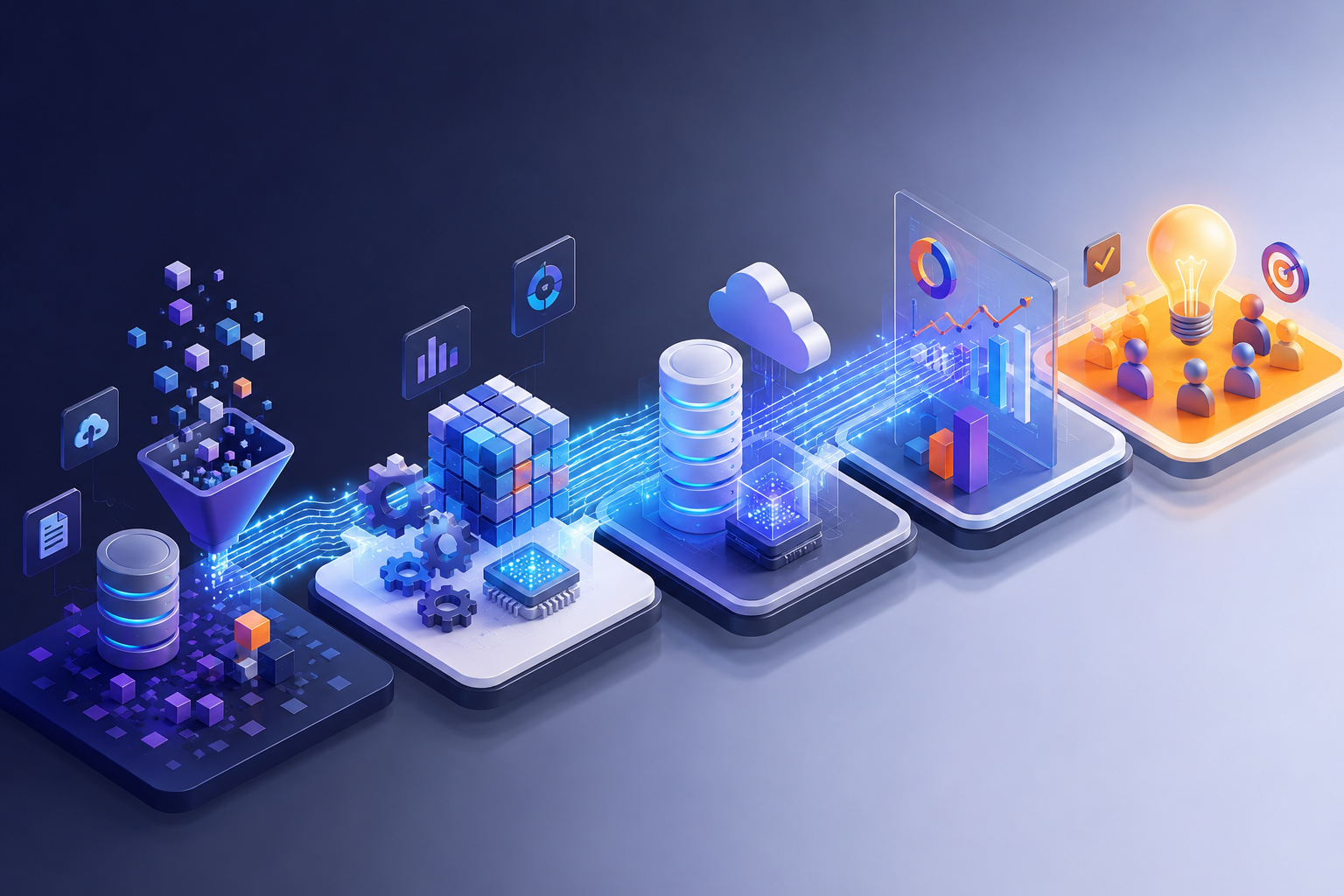
changing demand from customers. The traditional approach in addressing the
above problems was to acquire the structured data from different systems like
sales systems, Customer Relationship Management (CRM) systems, and transaction
systems, to process the data in a data warehouse, and then generate reports and
graphs based on the acquired data. Thus, the company receives the result that
helps to get a good understanding of the events happen, but this process is
usually batch-oriented, relies on a limited data set, and is oriented mainly on
human interpretation of the information.
The rise of AI has fundamentally changed what organisations expect from
their data infrastructure. Business leaders are no longer asking where their
data resides. They want to know whether their data platforms can power AI
applications, support real-time decision-making, and provide the context
intelligent systems need to operate effectively.
This shift is
visible across the industry. Microsoft has been expanding Fabric with AI
capabilities, including natural-language-style functions in Fabric Data
Warehouse and positioning Fabric and Microsoft Databases as a foundation for
agentic applications.
AWS is pursuing a similar direction through Amazon Redshift, SageMaker,
and its broader data and AI stack. Google Cloud continues to evolve BigQuery
with AI-assisted analytics and multimodal capabilities, while Snowflake is
investing in its AI Data Cloud and Cortex AI services. Databricks has expanded
its lakehouse approach to bring data engineering, analytics, machine learning,
governance, and generative AI together. The open-source ecosystem is evolving
alongside these platforms, with technologies such as Apache Iceberg and Apache Spark supporting
scalable data management and processing.
Different
vendors and technologies may use different terminology, but the direction is
consistent: the data platform is evolving into an AI platform.
A 2026 study on AI-ready
data platforms found that 62% of organisations still rely on traditional data
warehouses as their dominant architecture. At the same time, 37% use data
lakes, 34% use lakehouse architectures, 27% use data mesh approaches, and 25%
use data fabric technologies. The warehouse remains important, but it is
increasingly becoming one component of a broader data ecosystem.
The Data Platform Is
Becoming Something Bigger
The important
change is not that enterprises are abandoning data warehouses. They are not.
Data
warehouses, data lakes, ETL pipelines, BI platforms, and analytical databases
will continue to play important roles. What is changing is how these components
work together.
For years, enterprises often operated with separate systems for
reporting, data science, machine learning, and analytics. AI is making those
boundaries increasingly difficult to maintain.
Today’s CIOs and data leaders want platforms that connect to these
environments, support both traditional and AI workloads, provide real-time
access to information, and maintain governance across the entire data
landscape.
The modern
data platform is therefore less about finding one technology that does
everything and more about creating an intelligent, connected, governed, and
context-ready layer across the existing data estate.
What Enterprises Expect
Today
The
conversation around enterprise data platforms has moved beyond storage,
reporting, and scalability. For CIOs and data leaders, the real question is
whether the data environment can keep pace with how the business itself is
changing.
As AI becomes embedded in customer experiences, operations, and
decision-making, enterprises need data platforms that can bring together
information from across the organisation and make it available in the right
context, at the right time, for the right purpose.
A platform
that can support yesterday’s reporting but cannot provide the context required
by an AI agent or a real-time decision engine is no longer enough.
This is creating a new set of expectations. Enterprises want to connect
structured and unstructured data rather than manage them as separate worlds.
They want business definitions, lineage, and governance to remain consistent as
data moves across analytics, AI, and operational systems. They want real-time
information to complement historical data, so decisions are based not only on
what happened but also on what is happening now.
Increasingly,
they also want the same data foundation to support everything from traditional
BI and machine learning to GenAI and emerging agentic applications.
The bigger
shift is that data is moving from being an analytical asset to becoming an
operational asset. It is no longer enough for data to explain the business; it
increasingly needs to help the business respond.
Consider a
retailer. A traditional data warehouse might tell the business which products
sold well last month, which stores underperformed, or how revenue compared with
the previous quarter.
An AI-ready data ecosystem can bring sales, inventory, customer
behaviour, pricing, and supply chain signals together to identify emerging
demand, recommend where inventory should be moved, personalise offers, and
trigger action before a business problem becomes visible in a quarterly report.
That is the expectation of shaping modern data platforms: not simply
faster access to more data, but the ability to turn connected, trusted, and
contextualised data into decisions and action.
Why the Traditional Model
Is Being Rethought
Traditional warehouses were designed primarily to consolidate structured
data, enforce quality, and provide a trusted source for reporting and business
intelligence. They worked exceptionally well to answer the question of what
happened.
AI introduces
a different requirement: understanding what is happening, why it is happening,
what could happen next, and what action should be taken.
Modern AI systems need semantic context, lineage, governance, streaming
data, and access to structure as well as unstructured information. An AI
assistant or recommendation engine is only as useful as the data and context
behind it. The same 2026 study found that 30% of organisations identified poor
data quality as the biggest obstacle to becoming AI-ready, followed by
fragmented data landscapes at 28% and slow IT processes at 25%.
The message
is clear: AI readiness is often a data problem before it becomes a model
problem.
Modernisation:
Evolve Rather Than Replace
For
enterprises that have spent years building their data estates, moving to an
AI-ready architecture is not simply about adopting a new platform. The bigger
question is what happens to the systems and investments already in place.
Should organisations lift and shift existing workloads or rebuild
everything from scratch?
In most
cases, neither extreme is necessary.
A lift-and-shift may modernise infrastructure without addressing
fragmented data, duplicated pipelines, or governance gaps. A complete rebuild,
meanwhile, can be costly and disruptive.
The more practical approach is progressive modernisation: retain what
works, modernise what has become a constraint, and connect both through a
stronger data architecture.
Existing
warehouses can continue supporting established reporting and regulatory
workloads, while platforms such as Databricks and Microsoft Fabric, alongside
open technologies such as Apache Iceberg, can support new analytics, data
engineering, AI, and machine learning use cases.
The goal is
not to replace everything. It is to make the existing data estate more
connected, contextual, governed, and AI-ready.
From Archive to Living
System
The easiest
way to understand the transition is this:
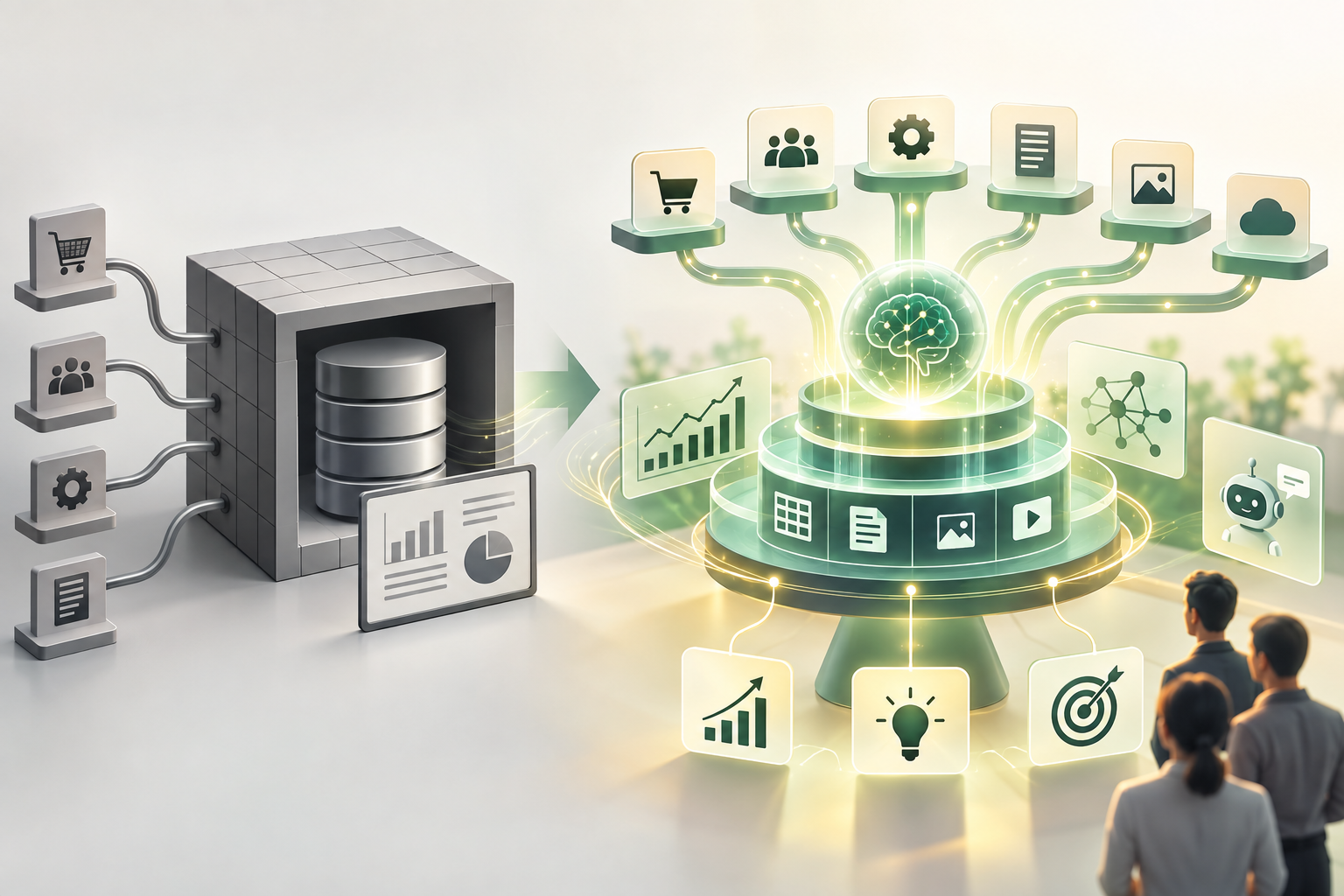
A traditional
warehouse is an archive. An AI-ready data platform is a living system.
The warehouse
stores trusted historical information. The modern data ecosystem connects
information across the enterprise, incorporates real-time signals, adds
business context, supports intelligent decision-making, enforces governance,
and makes data usable by both people and intelligent systems.
This is why the shift from data warehouses to AI-ready data platforms is
more than a technology upgrade. It represents a change in what enterprises
expect their data to do.
The
warehouse, therefore, is not disappearing. It is becoming part of something
larger.
The organisations that succeed will not necessarily be those that adopt
the newest platform first. They will be those that understand what to keep,
what to modernise, what to connect, and where AI can create measurable value.
Because in
the AI era, the most valuable data platform is not the one that simply stores
information.
It is the one that turns data into context, context into intelligence, and intelligence into action.